Introduction: Your Next High-Altitude Calling
Choosing your next high-altitude adventure is a decision filled with excitement and anticipation. For many, the choice narrows down to two iconic, yet fundamentally different, peaks: Mount Toubkal in Morocco and Mount Kilimanjaro in Tanzania. Toubkal, the crown of North Africa’s Atlas Mountains, offers a rugged, culturally rich, and condensed trekking experience. Kilimanjaro, the legendary “Roof of Africa,” presents a longer, more diverse journey to one of the world’s Seven Summits. This guide is designed to dissect these two magnificent mountains, moving beyond simple difficulty ratings to compare the core aspects of each trip—from the physical demands and logistical realities to the cultural immersion and overall experience, helping you decide which high-altitude calling is the right one for you.
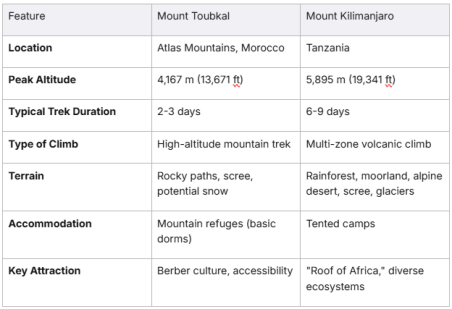
The Mountains at a Glance: Fast Facts Comparison
Before diving into the details, a direct comparison of the fundamental statistics provides a clear starting point. This at-a-glance view highlights the immediate differences in scale, duration, and location that shape each trek.
Challenge Level & Physical Demands: How Do They Stack Up?
While both mountains demand a good level of fitness, the nature of their challenges differs significantly, primarily due to altitude, terrain, and weather.
Altitude and Acclimatization
The most critical distinction is the sheer altitude. At 5,895 meters, Kilimanjaro towers nearly 1,700 meters above Toubkal. This massive difference in elevation makes altitude sickness a far more significant and dangerous risk on Kilimanjaro. A successful Kilimanjaro trip hinges on a slow and steady ascent—the “pole pole” (slowly, slowly) philosophy. Longer routes of 7, 8, or 9 days are highly recommended to allow your body the crucial time it needs to acclimatize. The climb progresses through distinct altitude levels, with each camp providing a step-up in elevation that tests your body’s adaptation.
Mount Toubkal, at 4,167 meters, still presents a formidable altitude challenge, and symptoms of altitude sickness are possible. However, the risk of severe illness is lower. The shorter duration of the trek means acclimatization happens rapidly over a 2-day period. Most itineraries involve a first day of walking to a base refuge at around 3,200 meters, allowing for one night to adjust before the final push to the summit. While the acclimatization time is shorter, the lower peak altitude makes the physical toll more manageable for many people.
Terrain and Walking Difficulty
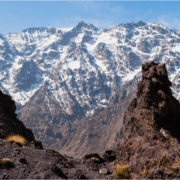
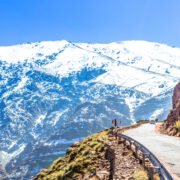
The day-to-day walking experience on each mountain is distinct. The Toubkal trek is characterized by a consistently rocky and rugged terrain. The paths are often steep, involving navigating loose scree and boulder fields. In winter, the upper slopes are covered in snow and ice, requiring crampons and an ice axe, which adds a layer of technical difficulty. The walking is strenuous and sustained, demanding strong legs and stable footing.
Kilimanjaro’s terrain is a journey through multiple climatic zones. The trek begins with gentle walking through lush rainforests, transitions to exposed moorlands with unique flora, and finally enters a stark alpine desert. The final summit climb is the most challenging part, involving a steep and relentless ascent on loose volcanic scree. While much of the walking on Kilimanjaro is on well-defined trails, the sheer length of the trip and the extreme altitude on summit night make it a profound test of endurance.
Weather Conditions
Weather on any high-altitude peak is unpredictable, but the patterns on Toubkal and Kilimanjaro vary. Toubkal’s weather is generally more stable outside the winter months, with hot, dry conditions in the summer. Winter (November to May) transforms it into a true mountaineering objective with freezing temperatures and significant snowfall.
Kilimanjaro’s proximity to the equator means it doesn’t have traditional winter/summer seasons. Instead, it has wet and dry seasons. The weather can change dramatically in a single day, taking you from warm tropical conditions at the base to arctic temperatures at the summit. Trekkers must be prepared for rain, strong winds, and sub-zero conditions, especially during the final night climb.
Logistics & Trip Planning: Comparing the Practicalities
The time, planning, and support required for each adventure differ substantially, influencing who each trip is best suited for.
Duration and Time Commitment
A trek up Mount Toubkal is a perfect short-haul adventure. The entire trip, including travel to and from Marrakech, can comfortably be completed in 3-4 days. This makes it an ideal objective for those with limited vacation time or looking for a long-weekend challenge. The approach is quick, with just a 90-minute drive from Marrakech to the trailhead in Imlil.
In contrast, a Kilimanjaro expedition is a significant time commitment. The trek itself lasts between 6 and 9 days, and when you factor in international travel days and potential rest days in Arusha or Moshi before and after the climb, the total trip time is closer to 10-14 days. This longer duration is not just for logistics but is essential for safe acclimatization.
Accommodation and Camp Life
On Mount Toubkal, trekkers typically stay in mountain refuges. These are basic, communal-style dormitories offering a mattress and blankets. While not luxurious, they provide essential shelter from the elements. This setup creates a social atmosphere where people from various groups share meals and stories.
The Kilimanjaro experience is defined by tented camping. Each night, the support crew works tirelessly to set up a private camp with sleeping tents, a mess tent for meals, and a toilet tent. This camp life is a core part of the adventure, offering a sense of self-sufficiency on the mountain. Waking up at a new camp each day as you ascend through different ecosystems is a unique aspect of the journey.
Guides and Support Teams
Both treks require the expertise of local guides. On Toubkal, you will be led by certified Berber guides, whose deep knowledge of the Atlas Mountains and local culture is an integral part of the experience. The support team is typically smaller, often consisting of a guide, a cook, and muleteers with their mules to carry the main luggage.
Kilimanjaro mandates a much larger support team. Due to park regulations and the expedition’s complexity, your group will be accompanied by guides, assistant guides, a cook, and a team of porters who carry all equipment, food, and personal gear. The professionalism and encouragement of these people are often cited as a highlight of the trip, and their role is indispensable for a successful summit attempt.
Cost & Budget: Financial Investment for Your Adventure
The financial commitment for these two adventures is starkly different. Mount Toubkal is a significantly more budget-friendly option. A standard 2-day guided trek can be arranged for a few hundred dollars per person, covering guides, accommodation, and meals on the mountain. Its proximity to Europe also means cheaper and quicker flights for many international travelers.
Kilimanjaro is a major financial undertaking. The cost reflects the longer duration, mandatory park fees (which constitute a large portion of the price), and the large support crew required. A quality trek with a reputable operator typically starts from around $2,000 and can go well
over $5,000 per person, excluding international flights. While cheaper options exist, they often come at the expense of guide welfare, safety standards, and acclimatization time.
Cultural Immersion & Overall Experience
Beyond the physical challenge, the cultural context of each trek offers a different kind of reward. The Toubkal trek is deeply embedded in the Berber culture of the Atlas Mountains. The journey starts in Imlil, a vibrant Berber village, and the entire experience is facilitated by local Berber people. This provides a genuine and direct connection to the region’s heritage, from the food you eat to the hospitality you receive in the refuge.
The Kilimanjaro experience offers less direct cultural immersion on the mountain itself, as you are trekking through a national park. However, the interaction with your Tanzanian guides and porters provides a wonderful window into their lives and culture. The camaraderie built with the crew over many days is a profound part of the journey. The experience is more about the personal challenge and the epic scale of the mountain’s changing landscapes.
Gear Essentials: Preparing for Both Peaks
While a core set of trekking gear is necessary for both, the specifics vary. For Toubkal in summer, standard three-season hiking gear suffices: broken-in hiking boots, layers of clothing, waterproofs, a head torch, and a good daypack. In winter, it becomes a different proposition, requiring insulated winter boots, crampons, an ice axe, and warmer layers.
Kilimanjaro’s demands are more extensive due to the extreme temperature fluctuations. You need gear for both warm, wet rainforests and arctic summit conditions. This means a robust layering system is critical, including thermal base layers, fleece mid-layers, and a high-quality down jacket and waterproof outer shells. A four-season sleeping bag, warm hats, gloves, and sunglasses are non-negotiable for the cold nights and the summit day.
Who Should Choose Which Adventure?
Your choice ultimately depends on your goals, experience level, budget, and available time.
Choose Mount Toubkal if:
- You have limited time and are looking for a powerful adventure in under a week.
- You are on a tighter budget.
- You are new to high-altitude trekking and want an achievable yet challenging introduction.
- You are seeking a rich cultural experience and interaction with local people.
- You want excellent training for a future, higher-altitude climb like Kilimanjaro.
Choose Mount Kilimanjaro if:
- You want to stand on one of the world’s Seven Summits and the “Roof of Africa.”
- You have at least 10-12 days to dedicate to the trip.
- You have a larger budget for a true expedition-style experience.
- You are motivated by a significant personal endurance challenge.
- You are fascinated by the idea of walking through five distinct ecosystems in a single trek.
Beyond the Summit: What’s Next?
Reaching the summit of either mountain is an incredible achievement, but it’s often just the beginning. A Toubkal trek can serve as a perfect stepping stone, building your confidence and experience for higher peaks. Many who conquer Toubkal set their sights on Kilimanjaro or peaks in the Alps. For those who have summited Kilimanjaro, the world of high-altitude trekking opens up, with potential next steps including Mount Elbrus in Russia or the trekking peaks of Nepal.
Conclusion: Your Ultimate Adventure Awaits
Both Mount Toubkal and Mount Kilimanjaro offer life-affirming experiences, breathtaking views, and a profound sense of accomplishment. Neither is “better”—they are simply different. Toubkal provides a condensed, culturally immersive, and accessible high-altitude trek, perfect for those seeking a quick yet rewarding challenge. Kilimanjaro delivers an epic, expedition-style journey through diverse landscapes, demanding more time, money, and physical endurance for the ultimate prize of standing on Africa’s highest point. By evaluating your personal resources, goals, and what you seek from the experience, you can confidently choose the mountain that calls to you. Your ultimate adventure is out there, waiting for your footsteps.